

Drone Survey 3D Model LOD: A Technical Guide to Level of Detail Standards

What if the most detailed model you've ever commissioned is actually the primary reason your project is over budget and behind schedule? Within the civil engineering and construction sectors, there's a common misconception that more data always equates to better outcomes. In reality, an incorrectly specified drone survey 3D model LOD often leads to bloated file sizes that crash Revit sessions or, conversely, models that lack the geometric reliability required for critical engineering decisions.
You've likely experienced the frustration of receiving a mesh that looks impressive but fails to meet RICS or ISO standards for structural analysis. This technical guide establishes a clear framework for specifying Level of Detail (LOD) and Level of Information (LOI) to ensure your BIM deliverables are fit for purpose. You'll master the cost-to-accuracy trade-off and learn how to align your tender requirements with the actual risks of your project. We'll also clarify the distinction between LOD and LOIN (Level of Information Need) to facilitate seamless integration into AutoCAD and other industry-standard software.
Key Takeaways
Identify the technical distinctions between LOD 100 and LOD 400 to ensure geometric representations align with specific project requirements and computational constraints.
Learn why a high drone survey 3D model LOD is only effective when underpinned by absolute geodetic accuracy and verified Ground Control Points (GCPs).
Determine the optimal specification for various applications, such as utilising LOD 100-200 for topographical earthworks or requiring LOD 300 for measured building surveys.
Establish a robust framework for specifying Level of Detail in tenders to guarantee compliance with RICS and ISO professional standards.
Understand the role of advanced UAV platforms in capturing the high-fidelity data necessary for precision-engineered LOD 400 outputs.
Table of Contents
Understanding LOD in the Context of Drone Surveying
Precision in digital twinning begins with a clear definition of requirements. In the context of aerial data acquisition, the drone survey 3D model LOD represents the degree of geometric complexity and spatial accuracy assigned to a digital asset. This concept, originally derived from computer graphics to manage rendering performance, has evolved into a cornerstone of modern Building Information Modelling (BIM). By adjusting the Level of Detail (LOD), surveyors can balance the need for high-fidelity visualisations with the practicalities of data processing and software interoperability.
The industry distinguishes between the physical geometry (LOD) and the underlying data metadata, known as the Level of Information (LOI). Whilst LOD describes the "shape" of a chimney stack or a structural beam, LOI provides the "identity", such as material specifications, installation dates, or maintenance records. For UK-based civil engineering and construction firms, these definitions are governed by the ISO 19650 series, ensuring that drone-derived models function as reliable components within a broader Common Data Environment (CDE).
The RICS Framework and UK Surveying Standards
Professional accountability in drone surveying is anchored in the RICS guidance note, "Measured surveys of land, buildings and utilities". This framework shifts the focus from generic data collection to "Purpose-Driven Surveying". It requires the surveyor to define the LOD based on the specific end-use of the model, whether it's for simple site massing or complex architectural restoration. By aligning drone outputs with these professional standards, we ensure that every model meets the rigorous demands of legal and structural documentation. This alignment is critical for projects operating under BIM Level 2 or higher, where digital twins must be both spatially accurate and logically structured.
Photogrammetry vs. LiDAR: Impact on LOD Capability
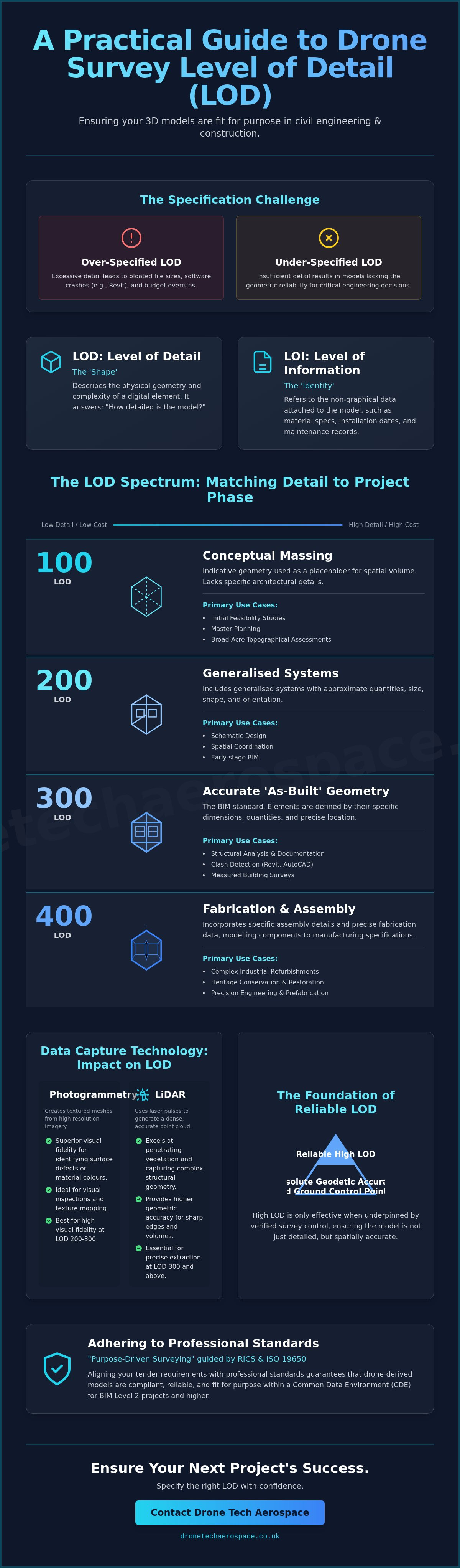
The technical method of data capture directly influences the achievable LOD. Photogrammetry relies on high-resolution imagery to create a textured mesh, offering superior visual LOD for identifying surface defects or material colours. Conversely, LiDAR (Light Detection and Ranging) provides a dense point cloud that excels at penetrating "noise", such as dense vegetation or complex structural lattice work. LiDAR is often the preferred choice for LOD 300 models where structural geometry must be extracted from cluttered environments.
Photogrammetry: Best for high visual fidelity and surface inspection at LOD 200-300.
LiDAR: Essential for precise geometric extraction and structural modelling in complex sites.
Point Cloud Density: Higher density allows for sharper edges and more accurate volumetric calculations.
The choice of sensor, whether high-resolution photogrammetry or multi-return LiDAR, fundamentally dictates the maximum viable LOD for any specific project.
The LOD Spectrum: From LOD 100 to LOD 400
Specifying the correct drone survey 3D model LOD is a strategic decision that impacts both project budgets and computational performance. The spectrum begins at LOD 100, which provides conceptual site massing and broad topographical features. These models are primarily used for initial feasibility studies or master planning. The geometry is indicative, serving as a placeholder for spatial volume rather than a definitive structural record. It's the most efficient choice for broad-acre assessments where specific architectural details aren't yet required.
As requirements become more rigorous, we transition to LOD 200. At this level, the model includes generalised systems with approximate quantities, size, and orientation. It's suitable for schematic designs where the focus is on spatial coordination rather than precise engineering. For most BIM-mandated projects, LOD 300 is the standard requirement. This level delivers accurate "as-built" geometry, where every element is defined by its specific dimensions and location. It provides the reliable foundation needed for structural analysis and clash detection in software like Revit.
The peak of the spectrum is LOD 400, which incorporates specific assembly details and precise fabrication data. Whilst capturing this level of detail via drone requires significant flight time and advanced processing, it's indispensable for complex industrial refurbishments or heritage conservation projects where every component must be modelled to its exact manufacturing specification. This level of granularity ensures that new fabrications will fit perfectly against existing structures during the construction phase.
LOD for External Envelopes and Roof Audits
Applying LOD 300 to external envelopes is a critical requirement for managing residential property portfolios. Our methodology integrates high-resolution orthomosaic mapping to ensure the geometric accuracy of every roof element, from parapet walls to drainage channels. This approach is fundamental for a professional residential roof drone survey, as it allows surveyors to identify structural displacements or material degradation with absolute precision. For those managing large estates, our Measured Building Surveys (3D Models) provide the high-fidelity outputs necessary for long-term asset maintenance and insurance valuations.
Internal Confined Spaces and LOD Challenges
Achieving a consistent LOD 200 or 300 in internal voids necessitates the use of ball/cage-drone technology. These environments are often characterised by signal interference and zero-light conditions, making traditional photogrammetry impossible. We overcome these constraints using SLAM (Simultaneous Localisation and Mapping) technology. This allows the drone to navigate and model internal spaces amongst dense steel structures or within storage vessels. The resulting point clouds maintain geometric integrity despite the lack of GPS, providing engineers with a reliable digital twin of areas that were previously inaccessible or too hazardous for manual measurement. This data is vital for assessing the internal structural health of industrial assets without the risks associated with human entry.
Accuracy vs. Precision: The Foundation of Reliable LOD
High visual detail does not guarantee engineering utility. A drone survey 3D model LOD refers primarily to the geometric complexity of digital elements, yet this metric is secondary to geodetic accuracy. In professional surveying, we distinguish between precision (the consistency of measurements) and accuracy (the proximity of those measurements to a known global coordinate). For civil engineering and heavy industry, a model must possess absolute accuracy to be viable. Without verified Ground Control Points (GCPs), even a visually stunning LOD 400 mesh remains a floating asset, disconnected from the real-world spatial context. We utilise RTK (Real-Time Kinematic) and PPK (Post-Processed Kinematic) drones to mitigate geometric distortion, ensuring the model's integrity across large-scale industrial sites.
Managing "noise" is another critical factor in the transition from aerial data to engineering-grade models. Raw point clouds often contain artefacts from moving vehicles, vegetation, or transient environmental factors. Whilst automated algorithms provide an initial filter, high-fidelity outputs require manual clean-up to ensure clean edges for CAD conversion. This process eliminates the "fuzziness" often found in low-quality photogrammetry, providing the sharp, planar surfaces necessary for accurate structural analysis and clash detection.
Ground Control and Geodetic Accuracy
To support an LOD 300 measured building survey, we typically deploy a minimum of five to eight GCPs per hectare, depending on site topography and structural complexity. These points must be tied to the Ordnance Survey National Grid (OSGB36) to ensure seamless compatibility with UK infrastructure projects and existing site plans. Precision without accuracy leads to catastrophic BIM alignment errors that can result in significant structural clashes during the construction phase.
Relative Accuracy: Ensures internal measurements (e.g., the width of a window) are consistent.
Absolute Accuracy: Ensures the entire model is correctly positioned on the earth's surface.
GCP Verification: Independent check points are used to validate the Root Mean Square Error (RMSE) of the final model.
Data Processing and QA Protocols
The transition from raw point clouds to structured 3D mesh models is governed by rigorous Quality Assurance (QA) protocols. We move beyond simple automated processing by implementing a multi-stage verification workflow. This involves comparing digital measurements against physical "check points" captured during the site visit. Manual clean-up remains a non-negotiable step for professional-grade models, as it ensures that the final deliverable reflects the actual as-built reality rather than sensor artefacts. Every model is verified against the requested LOD standards before delivery, ensuring it is fully compatible with Revit, AutoCAD, and other BIM environments.
Matching LOD to Your Project Requirements
Selecting the appropriate drone survey 3D model LOD requires a meticulous assessment of the project’s technical objectives. For large-scale Drone Topographical Land Surveys, LOD 100 or 200 is typically sufficient. These models prioritise surface terrain and major site features, providing the necessary data for earthworks and volumetric analysis without the computational overhead of high-fidelity geometry. Architectural renovations and structural alterations necessitate the precision of LOD 300. This level ensures that every load-bearing element and architectural detail is captured as an as-built record, providing a reliable foundation for BIM integration. This distinction prevents the common pitfall of paying for data that remains unused or becomes a technical liability.
High-value industrial assets often require LOD 400 outputs for integrity assessments. These models include specific fabrication details, allowing engineers to monitor fatigue or deformation at a component level. For heritage conservation, the challenge lies in balancing geometric LOD with high-resolution texture mapping. Whilst a lower geometric LOD might suffice for simple structural forms, the photorealistic textures are vital for documenting the condition of historical masonry and ornate features. This purpose-driven approach ensures that the digital twin serves its specific conservation or engineering function without unnecessary data bloat.
Cost and Time Implications of Higher LOD
The relationship between LOD and project resources is non-linear. Moving from LOD 200 to LOD 300 results in an exponential increase in data processing time and manual clean-up requirements. Over-specifying detail often leads to unmanageable file sizes that impede performance in Revit or AutoCAD. Professional project managers must balance technical depth with budget constraints, ensuring the model supports the highest-risk decision without introducing unnecessary complexity. A model that is too large to open on a standard workstation provides zero value to the design team.
Specifying LOD in Tenders and Briefs
Effective procurement starts with a precise brief. When specifying requirements in tenders, define the Area of Interest (AOI) clearly. It's often more efficient to request a hybrid approach, where critical structures receive LOD 300 treatment whilst surrounding terrain remains at LOD 100. Ensure your brief includes a checklist for coordinate systems, desired file formats, and specific tolerances for absolute accuracy. For complex industrial requirements, it is essential to partner with a provider capable of delivering RICS-compliant data. Explore our Drone Industrial Site Inspections & Surveys to see how we align technical specifications with operational outcomes.
The Drone Tech Aerospace Standard for 3D Modelling
Drone Tech Aerospace operates at the intersection of aerial robotics and geospatial engineering. Our commitment to RICS-compliant measured building surveys ensures that every 3D model we deliver adheres to the highest professional standards in the UK market. We recognise that a drone survey 3D model LOD is not merely a visual asset but a critical legal and engineering document. By maintaining strict adherence to ISO 19650 protocols, we provide corporate clients with the security and accountability required for high-stakes industrial projects. Our status as a premium provider is built on a track record of handling complex, large-scale requirements where precision is the only acceptable metric.
Our operational capacity is built upon a fleet of advanced UAV platforms equipped with RTK and PPK positioning systems. These high-capacity systems allow us to capture the high-density point clouds necessary for LOD 300 and LOD 400 outputs with absolute geodetic precision. Beyond simple geometry, we offer the unique capability to integrate multi-spectral data directly into the 3D environment. This includes the precise overlay of thermographic signatures and fugitive methane gas detections onto high-LOD geometric models. Such data fusion provides a comprehensive digital twin that supports both structural analysis and environmental compliance monitoring within a single, unified dataset.
Bespoke Solutions for Complex Infrastructure
We specialise in tailoring LOD specifications to meet the unique demands of heavy industry and civil engineering. For industrial chimney surveys and wind turbine inspections, we deploy specialised sensors that capture sub-millimetre surface detail. Our methodology often involves combining internal data from ball/cage-drones with external mapping to create a unified 3D record of an asset's entire structural fabric. This holistic approach is detailed in our industrial drone inspection strategy, which outlines our 2026 framework for maintaining asset integrity. This bespoke integration ensures that no structural void or external face remains undocumented.
Delivery and Support: Beyond the 3D Model
A high-LOD model is only valuable if it integrates seamlessly into your established technical ecosystem. We deliver data in native formats ready for immediate use, including .rvt for Revit, .dwg for AutoCAD, and .ifc or .obj for broader BIM interoperability. Our service extends beyond the delivery of raw files. We provide technical consultancy to help your engineering teams navigate and utilise the delivered LOD effectively. This ensures that the transition from aerial data to actionable insight is efficient and mathematically sound. Contact our specialists to discuss your upcoming UK-wide survey requirements and establish a technical specification that aligns with your specific operational goals.
Implementing Professional Standards for Your Digital Twin
Selecting the appropriate drone survey 3D model LOD is a critical decision that dictates the long-term utility of your BIM data. By aligning geometric complexity with specific engineering risks, you'll avoid the dual pitfalls of data insufficiency and computational bloat. Reliable 3D modelling requires more than high-resolution imagery; it demands absolute geodetic accuracy underpinned by RICS-compliant methodologies and verified Ground Control Points.
With over 10 years of operational experience across the UK, we specialise in the high-precision capture of industrial and heritage assets. Our workflows are fully compliant with CAA regulations and RICS professional standards, ensuring your data is defensible and accurate. Request a technical consultation for your 3D drone survey to define a specification that supports your project's unique requirements. Ensuring your digital assets are fit for purpose is the first step toward successful project delivery.
Frequently Asked Questions
What is the most common LOD for drone-based measured building surveys?
LOD 300 is the industry standard for professional measured building surveys because it represents accurate as-built geometry. This level includes structural elements and architectural features defined by their specific dimensions, orientations, and locations. It provides the reliable foundation required for clash detection and BIM coordination. Whilst LOD 200 may suffice for early feasibility studies, the geometric reliability of LOD 300 is essential for detailed design and renovation phases.
Can drone surveys achieve LOD 400 for architectural details?
Drone surveys can achieve LOD 400 for architectural details when utilising high-resolution sensors and advanced photogrammetry workflows. This level incorporates specific assembly details and precise fabrication data. Achieving this degree of granularity requires increased flight time and meticulous manual clean-up of the resulting mesh. It's typically reserved for high-value asset integrity assessments or complex heritage conservation projects where every component must be modelled to its exact manufacturing specification.
How does LOD affect the file size of a 3D model?
Increasing the drone survey 3D model LOD causes an exponential rise in file size. Higher detail levels require denser point clouds and more complex polygonal meshes to represent geometry accurately. This can lead to unmanageable datasets that impede software performance in Revit or AutoCAD. We recommend a purpose-driven approach, where high LOD is only applied to critical areas of interest to maintain computational efficiency across the broader project environment.
Is there a difference between LOD in photogrammetry and LiDAR?
There's a significant technical distinction between photogrammetry and LiDAR regarding LOD capabilities. Photogrammetry excels at visual fidelity, providing high-resolution textures for surface inspections and material identification. LiDAR dominates in geometric precision and structural "noise" penetration, such as through dense vegetation or complex lattice work. LiDAR is often the superior choice for extracting the clean structural geometry required for LOD 300 or LOD 400 models in cluttered industrial environments.
Do I need a higher LOD for a heritage site inspection?
Heritage site inspections often necessitate a higher LOD to document delicate architectural features and material conditions accurately. Conservation records typically require LOD 300 or LOD 400 to ensure that every ornate element is captured as a precise digital twin. This level of detail provides a reliable baseline for monitoring structural decay or planning sympathetic restorations. We balance geometric complexity with photorealistic textures to create comprehensive and authoritative conservation records.
How much does it cost to increase the LOD of a 3D drone survey?
The cost of increasing a drone survey 3D model LOD is determined by the additional flight time, data processing, and manual clean-up required. Higher detail levels demand a significant increase in manual labour to ensure geometric accuracy and clear structural edges. Whilst we don't quote fixed rates without specific site assessments, clients should expect the resource requirements to scale with the complexity of the requested geometric representation and the required absolute accuracy.
What software is best for viewing high-LOD drone models?
High-LOD drone models are best viewed in industry-standard BIM and CAD platforms such as Autodesk Revit, AutoCAD, or Navisworks. These tools are designed to handle complex geometry and provide the necessary measurement capabilities for engineering tasks. For collaborative reviews without specialist software, cloud-based platforms like PIX4Dcloud or DroneDeploy offer efficient ways to visualise and interrogate high-fidelity 3D meshes within a standard web browser, ensuring data accessibility for all stakeholders.
Can LOD 300 models be used for structural calculations?
LOD 300 models are suitable for structural calculations as they provide verified as-built geometry with accurate dimensions and orientations. This level of detail allows engineers to assess load-bearing paths and conduct structural analysis with high confidence. However, the reliability of these calculations depends entirely on the underlying absolute geodetic accuracy of the survey. We ensure every model is underpinned by verified Ground Control Points to support critical engineering decisions and professional accountability.


Comments